
Why Ecuador

If you are a nature lover, you should know that Ecuador is considered one of the most diverse areas of the world with some 25,000 species of plants and animals.
Though small in size, the country packs incredible natural and cultural wonders:
• The Galapagos Islands were the inspiration behind the Theory of Evolution. Charles Darwin explored the islands during a five-week visit in 1835.
• Mount Chimborazo is the farthest point on Earth’s surface from the planet’s center, beating Mount Everest. It rises at 6,263 meters (20,548 feet) above sea level.
• The Equator is the middle of the world, where the French Geodesic Mission organized a scientific expedition to Ecuador to measure the shape of the Earth in 1736.
Ecuador is the historical cradle of cacao, with archaeological and genetic evidence showing that the Mayo-Chinchipe culture domesticated and consumed cacao in the upper Amazon region (at Santa Ana-La Florida in Palanda) at least 5,300 years ago—predating Mesoamerican use by over 1,500 years.
It is considered the world’s leading exporter of bananas and is globally known for the beauty and quality of their flowers. In spiritual and holistic traditions, flowers are medicinal because they have a very high vibrational frequency associated with love and light.
Ecuador is the original producer of the famous Panama Hat. Despite the name, the hat originated and is still primarily handcrafted in Ecuador.
In 2008, Ecuador became the first country in the world to recognize the rights of Nature in their constitution. It has 14 Indigenous nationalities that are considered fierce guardians of the Amazon rainforest.
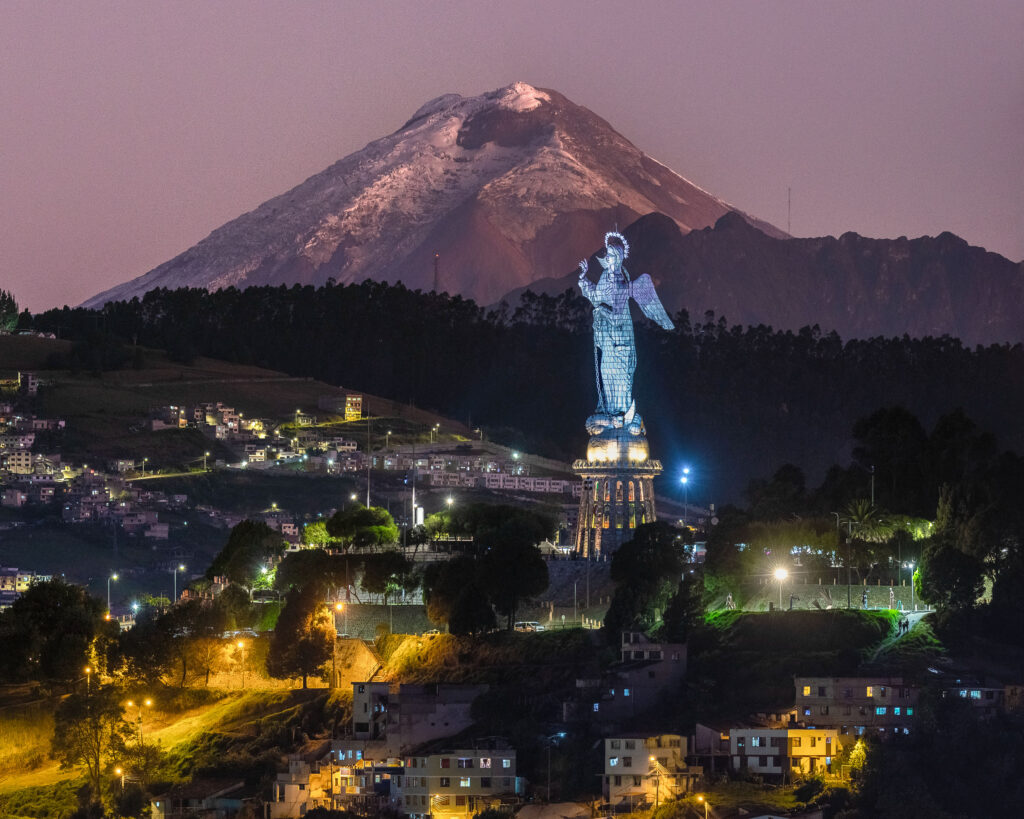
A Historic Capital
San Francisco de Quito was designated as the first UNESCO World Heritage site in 1978 and is one of the highest capital cities in the world at 2,850 meters (9,350 feet) above sea level. Quito is known as “Light of America” because it became the first city in Latin America to declare independence from Spanish colonial rule on August 10, 1809.
Founded in 1534 on ancient Inca ruins, it features the largest and best-preserved historic center in Latin America. It has more than 100 historic churches and chapels, making it one of the densest concentrations of colonial religious architecture in South America.
With spring-like weather all year, Quito is considered the “Orchid Capital of the World”, housing thousands of unique species